




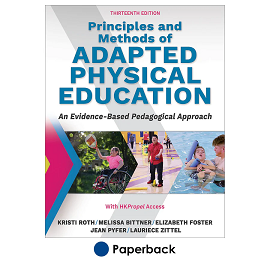
Principles and Methods of Adapted Physical Education, 13th Edition With HKPropel Access, continues its legacy as an evidence-based resource for undergraduate- and graduate-level students training to work with individuals with disabilities in a physical education setting. The content and strategies presented help educators dive deeply into how to build a successful program for the teaching of adapted physical education.
This edition incorporates the Adapted Physical Education National Standards and addresses contemporary issues confronted by teachers today:
Culturally responsive teaching strategies to help educators build learning environments where all students feel a sense of belonging
Social-emotional learning and trauma-sensitive teaching, in alignment with the Collaborative for Academic, Social, and Emotional Learning (CASEL) framework
Technology use in adapted physical education to assist in daily planning, teaching, and assessment strategies
Positive behavioral interventions and supports within an adapted physical education context
Authored by experienced adapted physical education practitioners and teacher trainers, Principles and Methods of Adapted Physical Education emphasizes understanding teaching methods and applying those methods when teaching students with disabilities. Practical instruction is offered for completing comprehensive evaluations, developing individualized education programs (IEPs), facilitating least restrictive learning environments, incorporating universal design for learning, understanding legal requirements, understanding safety considerations for specific disabilities, and determining core elements of a successful adapted physical education program.
This edition incorporates the Adapted Physical Education National Standards and addresses contemporary issues confronted by teachers today:
Culturally responsive teaching strategies to help educators build learning environments where all students feel a sense of belonging
Social-emotional learning and trauma-sensitive teaching, in alignment with the Collaborative for Academic, Social, and Emotional Learning (CASEL) framework
Technology use in adapted physical education to assist in daily planning, teaching, and assessment strategies
Positive behavioral interventions and supports within an adapted physical education context
Authored by experienced adapted physical education practitioners and teacher trainers, Principles and Methods of Adapted Physical Education emphasizes understanding teaching methods and applying those methods when teaching students with disabilities. Practical instruction is offered for completing comprehensive evaluations, developing individualized education programs (IEPs), facilitating least restrictive learning environments, incorporating universal design for learning, understanding legal requirements, understanding safety considerations for specific disabilities, and determining core elements of a successful adapted physical education program.