



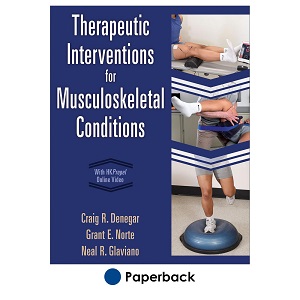
Therapeutic Interventions for Musculoskeletal Conditions features a case study that builds upon itself in each part, taking the student from the beginning of a plan of care at the initial evaluation of an injury and through the various steps and progressions of treatment. This unique approach helps the student see how interventions can be implemented, progressed upon, and used in conjunction with each other.
Split into five parts, each section of Therapeutic Interventions for Musculoskeletal Conditions walks students through a phase of patient recovery:
Part I covers the initial evaluation and creation of a plan of care.
Part II discusses the neurophysiology behind pain transmission, signal modulation, tissue injury, inflammation, and pain science.
Part III focuses on understanding limitations in range of motion and discusses various therapeutic modalities and manual interventions used to restore motion.
Part IV highlights the importance of neuromuscular control in the healing process and ways to facilitate recovery.
Part V explores the role of mechanical signaling and exercise in tissue recovery.
Students and professionals alike will develop stronger decision-making skills when determining the safest and most effective use of different treatment methods with Therapeutic Interventions for Musculoskeletal Conditions.
Split into five parts, each section of Therapeutic Interventions for Musculoskeletal Conditions walks students through a phase of patient recovery:
Part I covers the initial evaluation and creation of a plan of care.
Part II discusses the neurophysiology behind pain transmission, signal modulation, tissue injury, inflammation, and pain science.
Part III focuses on understanding limitations in range of motion and discusses various therapeutic modalities and manual interventions used to restore motion.
Part IV highlights the importance of neuromuscular control in the healing process and ways to facilitate recovery.
Part V explores the role of mechanical signaling and exercise in tissue recovery.
Students and professionals alike will develop stronger decision-making skills when determining the safest and most effective use of different treatment methods with Therapeutic Interventions for Musculoskeletal Conditions.